


SCRANTON, Pa.–Twenty-five years after the Sept. 11 terrorist attacks, the University of Scranton is helping students born after 2001 understand the tragedy’s lasting impact, honor the memory of those lost, and carry its lessons into the future.
On the morning of Sept. 11, 2001, now a quarter of a century ago, 2,996 people died as a result of the terrorist attacks on the United States of America. Of that number, 2,977 were victims killed. Thousands were civilians; 343 were firefighters; 60 were police officers; 32 were relatives of Royals; and five were University of Scranton alumni. Those who died were fathers and mothers, sons and daughters, grandparents and grandchildren, spouses, friends, coworkers and more to the family and friends left behind. The pain of their loss didn’t just end with the attacks – it was just beginning.
For people born after 9/11, it can be difficult to see the grieving that continues everyday. Survivor’s guilt, physical injuries, emotional trauma, and cancer are just some of the sufferings the people who lived 9/11 must endure. These are burdens often carried silently and can exist unbeknownst to the generations born post 9/11. It is important that the memory of the lost and the struggles of the living are acknowledged and understood by younger generations.
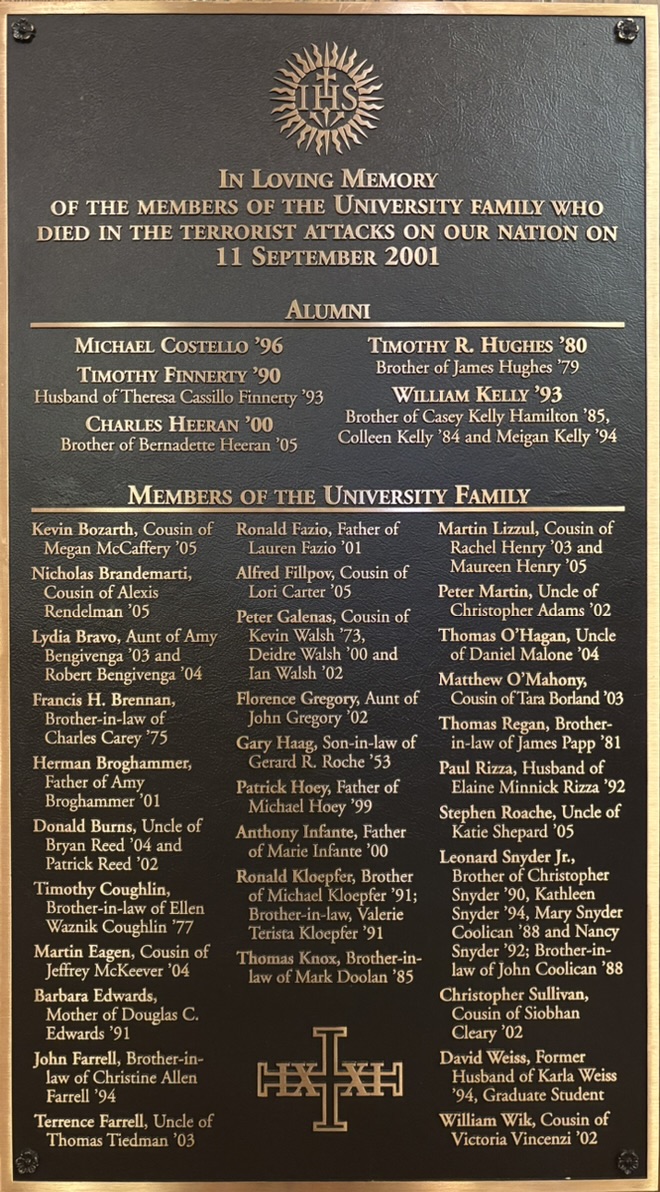
The University of Scranton is making sure that happens for Michael Costello ’96, Timothy Finnerty ’90, Charles Heeran ’00, Timothy Hughes ’80, William Kelly ’93, the 32 relatives of Royals, the rest of the 2,977 victims killed, and the countless people who were and are affected by the tragedy.
On this 25th anniversary year, the university is offering a few classes surrounding 9/11 designed to educate young people who did not experience that terrible day. These courses help young people make sense of a catastrophe that often seems senseless.
The two classes being offered at the university this fall are Making Meaning of 9/11, a first-year seminar, and September 11, 2001 and Beyond, a political science class. Dr. Mike Allison, Department of Political Science Chair, created the September 11, 2001, and Beyond class in the midst of the War on Terror.
The class first ran in “2012 (then again in 2014 and2015). The course itself grew out of an honors tutorial I had developed in 2009 and the ‘Finding Justice after 9/11’ programming that Dr. [Teresa] Grettano and I organized through Education for Justice (now called The Ellacuría Initiative) to commemorate the 10-year anniversary,” Dr. Allison said.
This semester, September 11, 2001, and Beyond is being taught by Dr. Gretchen Van Dyke of the Department of Political Science.
“This class is an upper division elective in PoliticalScience that is offered at least once every three years… [We] agreed that it should be offered again this semester – to coincide with the 25th anniversary of the 9/11 attacks,” Dr. VanDyke said. Teaching a course on this subject has many challenges, but the university’s wonderful faculty are prepared and experienced.
“I really enjoy helping current students come to an understanding and appreciation of the incredible breadth and depth of that day and the myriad implications of the September 11 attacks, which continue to impact the United States to this day,” Dr. Van Dyke said.
Dr. Allison is teaching one section of the Making Meaning of 9/11 first-year seminar – a course created by Dr. Grettano, of the Department of English and Theatre. Dr. Grettano teaches another section of the class and explained that she first taught the course in the fall of 2011. This class is unique.
“The class changes every time I teach it because the world changes. Some semesters we focused on Afghanistan and the War on Terror –others on refugees, Syria, COVID and first responders,” Dr. Grettano said. When the course first ran, students were around eight years old when 9/11 happened. Students taking the class now were not even born when 9/11 happened explained Dr. Grettano.
Additionally, these faculty members lived during 9/11, providing them with the insight and perspective needed to educate those born after that day. “As a native New Yorker, New York City and the World Trade Center have a special meaning to me. At different points in time, my parents and brother worked in the Twin Towers, and for a brief time I worked across the street in the World Financial Center,” Dr. Allison explained. “Several people from my hometown in Rockaway Beach, New York, were killed in the attacks, but the person I was closest to escaped before the building collapsed,” Dr. Allison did clarify that he was living in Florida at the time of the attacks.
Dr. Van Dyke also vividly remembers the morning of Sept. 11, 2001 and what followed. “I entered my classroom at 1 p.m. on September 11, 2001, when [it] was unfolding before our eyes just a couple hours away from our campus – in lower Manhattan, at the Pentagon in the DC Metro area, and in Shanksville, PA.”
Dr. Van Dyke continued, “That day—and the days, weeks, months, and several years that followed—were emotionally difficult for all of us here on campus, as we learned that we had so many connections to those who lost their lives that day and/or were deeply affected by what happened that day.”
Dr. Grettano, and her family, bore the burden of 9/11, and still do. “September 11 is a part of my daily life – it is still part of every day for my sister and her husband, and by extension their kids and our family.” Dr. Grettano referenced her friends who were/are New York City first responders, friends who work in construction, and friends in the military explaining how 9/11 continues to be a part of all of their lives every day.
“Teaching this course is my contribution, my service, and a way to honor those who were and are making much greater sacrifices than I am,” Dr. Grettano said.
Dr. Grettano also made note of some 9/11 related events being hosted in Loyola Science Center room 133 including films “No Responder Left Behind” on Sept. 23, “Restrepo” on Oct. 8, “Inside the Pentagon” on Nov. 4, “United 93” on Dec. 8, and visits from FeelGood Foundation representatives on Sept. 28 and from Mark Volk on Nov. 11. These events are open to all students.
The legacies of Costello ’96, Finnerty ’90, Heeran ’00, Hughes ’80 and Kelly ’93 live on at the University of Scranton.
Their names, along with the names of the relatives of Royals, can be found inscribed on a memorial plaque in the Madonna Della Strada Chapel, and each year a 9/11 memorial ceremony is held. Additionally, one of the first-year dorms, Giblin-Kelly Hall, was dedicated with the namesake of alumnus William Kelly ’93. The Michael S. Costello ’96 Memorial Scholarship and the Timothy J. Finnerty ’90 Memorial Scholarship were created to continue these alums’ legacy according to the Scranton Journal.
These alumni once sat in the same seats that current students do, took the same classes, and likely had very similar Scranton experiences. While memorials, scholarships and dorms may now bear their names, it is crucial to remember the Scranton alumni, and every victim of 9/11 not as a name on a wall – but rather as a person. In keeping their memories alive as people, one truly has the ability to empathize with the victims of a tragedy before one’s time.


.jpeg)



.svg)