


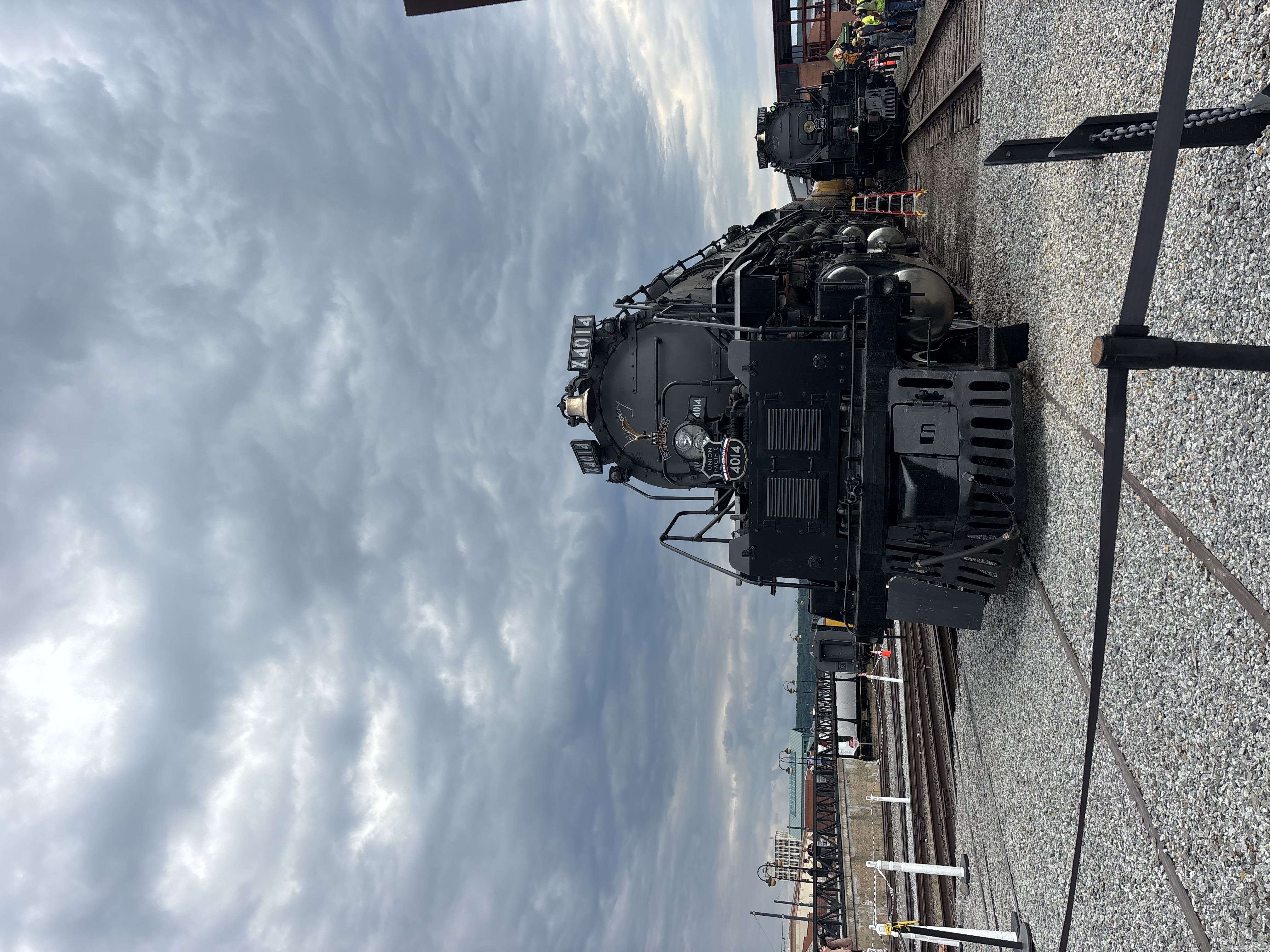
SCRANTON, Pa. — Steamtown National Historic Site in downtown Scranton hosted the Union Pacific Big Boy No. 4014 train this past June as part of its coast-to-coast tour for America’s 250th anniversary.
Union Pacific commissioned 25 Big Boy locomotives in the 1940s to haul heavy freight in the West. Big Boy No. 4014 is one of eight Big Boy locomotives still on display to the public and the only one that still operates today.
Steamtown announced at the end of April they would be hosting the locomotive from June 14 through July 1, the longest stop on its tour. More than 111,000 people flocked to Steamtown over the course of 17 days to see the massive locomotive which would ultimately become Steamtown’s largest event in history. For perspective, Steamtown recorded 60,844 visitors in all of 2025 according to a National Park Service report.
“The response from the local community was extraordinary,” said Steamtown Public Affairs and Management Assistant Megan Stevens. “While No. 4014 certainly brought railroad enthusiasts from across the country – and across the globe – to Scranton, what was especially exciting for us was seeing how many people from our own community came out to experience Steamtown, some for the first time and others returning after many years.”
Stevens said hosting an event of this scale was not easy. Months of planning were compressed into a short amount of time. Plans for No. 4014’s visit were kept confidential until Union Pacific’s official announcement in April, leaving just six weeks to publicly communicate the event and coordinate with the surrounding community. While they had to consider everything from timed entry reservations to parking and security, their biggest challenge was prepping for the sheer amount of people who wanted to see it.
Steamtown worked closely with the city of Scranton, Lackawanna County, law enforcement and emergency services. They also welcomed more than 50 National Park Service (NPS) employees from parks around the country to supplement their own staff. A total of 120 volunteers contributed over 3,000 hours and worked alongside these employees to ensure the event ran smoothly.
“There was an enormous amount happening behind the scenes that most visitors hopefully never had to think about, which, in many ways, is the goal,” said Stevens.
What made 4014’s visit to Scranton special was the rare sight of two Big Boy locomotives displayed side by side. Steamtown is home to another Big Boy train, No. 4012, which is preserved and cared for by the NPS. While many are followers of No. 4014 because it is the only operating Big Boy, what attracted arguably even more attention was the chance to see two side by side, something that could only happen here in Scranton, Pennsylvania.
Ironically, Jeremy Komasz, superintendent of Steamtown, decided to relocate No. 4012 from the south side of the parking lot to the more visible north side just months before No. 4014’s visit.
“I would see the Big Boy every day when I came into work and think, ‘Man, I wish more people spent more time around this,’” said Komasz during an interview with High Point Perspective on YouTube.
Together, visitors got to witness two versions of railroad preservation: a locomotive restored to operation and one preserved as an artifact.
“Seeing them side by side, surrounded by thousands of people who had traveled to Scranton specifically for that moment, was pretty extraordinary. We’ve called it a ‘first-in-a-lifetime’ event because, while it was historic, we certainly hope it doesn’t have to be the last time,” said Stevens.
This event created a much larger impact beyond Steamtown. The people who came to see the Big Boy reunion also shopped at businesses, ate at restaurants, explored local attractions and stayed in local hotels. The Greater Scranton Chamber of Commerce estimated the event generated “between $16 million to $17 million in economic impact throughout eastern Pennsylvania.”
People finally got to experience Steamtown and the city of Scranton in a way that is often overlooked, as a heritage tourism destination. As one of the few places in the country where visitors can experience railroad history in an authentic railroad setting, Stevens hopes people remember that Steamtown gave them a reason to discover something more.
“As part of the National Park System, we use that setting to tell the broader American railroad story,” Stevens explained. “[We’re] connecting visitors to the people, technology – and transportation networks that connected communities, fueled industry – and helped shape the nation.”



.jpeg)


.svg)